As I was falling asleep one night I began to think about regular polygons inscribed in the unit circle. I imagined adding more and more sides to the polygon and watching as the area of the polygon approached the area of the circle. I wondered how to calculate the ratio of the area of the polygon to the circle, and what the curve would look like if I were to plot the values for increasing numbers of sides. I wondered about similar plots for polygons circumscribing the unit circle. I understood that for large numbers of sides the ratio of the areas between the polygon and the circle would approach one, and likewise the ratio of the areas between the inscribed and circumscribed polygons would approach one, albeit more slowly as the circumscribed polygon will always be larger than the unit circle. Would the approach to one be symmetric for the case of the inscribed versus the circumscribed polygon?
Inscribed Polygons
I realized calculating the area of a regular polygon with 

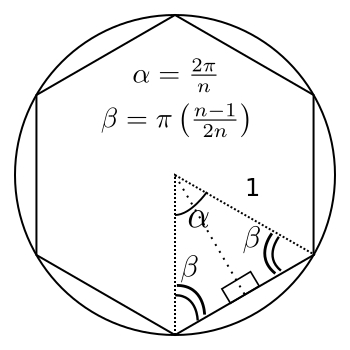
The triangle can be divided into two right triangles whose non-right angles are 


In total there are 


Circumscribed Polygons
The same procedure as before for calculating area applies to a regular polygon circumscribing the unit circle.
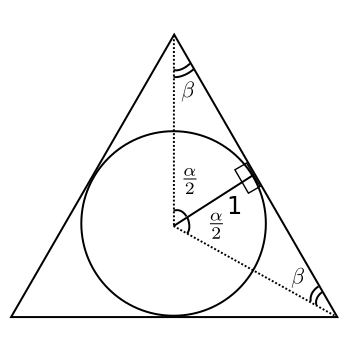
Finding the area of the right triangle is trivial in this case as the base is just the radius of the unit circle and the height is the tangent of 

Ratio of Areas
I’m interested in the ratio of the area of the polygon to that of the unit circle and seeing how the ratio changes with various values of 


I’m also interested in the ratio of the area of the inscribed polygon to the circumscribed polygon, as this will approach 1 for large

The following figure shows a plot of each function for values from 3 to 30.
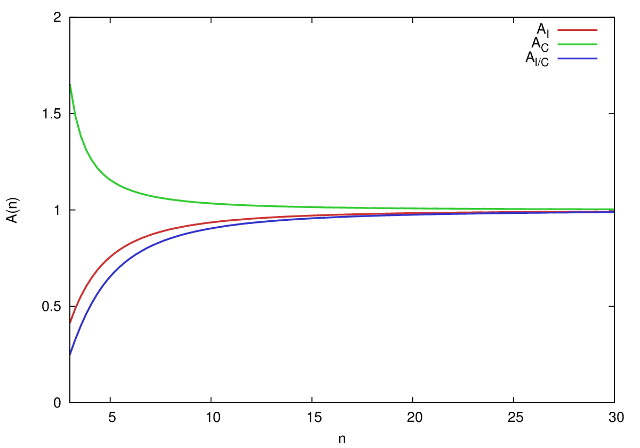
It’s clear from the plot that 

In an attempt to get a simpler explanation of the shape of the curves the ratio functions can be expanded into the first few terms of their respective Taylor series.
![\begin{aligned} A_I(n) &= \frac{n}{2\pi} \sin\left(\frac{2\pi}{n}\right) \\ &= \frac{n}{2\pi} \left[\frac{2\pi}{n} - \frac{1}{6}{\left(\frac{2\pi}{n}\right)}^3 + \frac{1}{120}{\left(\frac{2\pi}{n}\right)}^5 + \dots\right] \\ &= \frac{n}{2\pi} \left[\frac{2\pi}{n} - \frac{1}{6}{\left(\frac{2\pi}{n}\right)}^3 + \mathcal{O}{\left(\frac{2\pi}{n}\right)}^5\right] \\ &\approx 1 - \frac{2\pi^2}{3n^2} \end{aligned}](https://s0.wp.com/latex.php?latex=%5Cbegin%7Baligned%7D+A_I%28n%29+%26%3D+%5Cfrac%7Bn%7D%7B2%5Cpi%7D+%5Csin%5Cleft%28%5Cfrac%7B2%5Cpi%7D%7Bn%7D%5Cright%29+%5C%5C+%26%3D+%5Cfrac%7Bn%7D%7B2%5Cpi%7D+%5Cleft%5B%5Cfrac%7B2%5Cpi%7D%7Bn%7D+-+%5Cfrac%7B1%7D%7B6%7D%7B%5Cleft%28%5Cfrac%7B2%5Cpi%7D%7Bn%7D%5Cright%29%7D%5E3+%2B+%5Cfrac%7B1%7D%7B120%7D%7B%5Cleft%28%5Cfrac%7B2%5Cpi%7D%7Bn%7D%5Cright%29%7D%5E5+%2B+%5Cdots%5Cright%5D+%5C%5C+%26%3D+%5Cfrac%7Bn%7D%7B2%5Cpi%7D+%5Cleft%5B%5Cfrac%7B2%5Cpi%7D%7Bn%7D+-+%5Cfrac%7B1%7D%7B6%7D%7B%5Cleft%28%5Cfrac%7B2%5Cpi%7D%7Bn%7D%5Cright%29%7D%5E3+%2B+%5Cmathcal%7BO%7D%7B%5Cleft%28%5Cfrac%7B2%5Cpi%7D%7Bn%7D%5Cright%29%7D%5E5%5Cright%5D+%5C%5C+%26%5Capprox+1+-+%5Cfrac%7B2%5Cpi%5E2%7D%7B3n%5E2%7D+%5Cend%7Baligned%7D+&bg=ffffff&fg=111111&s=0&c=20201002)
![\begin{aligned} A_C(n) &= \frac{n}{\pi} \sin\left(\frac{2\pi}{n}\right) \\ &= \frac{n}{\pi} \left[\frac{\pi}{n} - \frac{1}{3}{\left(\frac{\pi}{n}\right)}^3 + \frac{2}{15}{\left(\frac{\pi}{n}\right)}^5 + \dots\right] \\ &= \frac{n}{\pi} \left[\frac{\pi}{n} - \frac{1}{3}{\left(\frac{\pi}{n}\right)}^3 + \mathcal{O}{\left(\frac{\pi}{n}\right)}^5\right] \\ &\approx 1 + \frac{\pi^2}{3n^2} \end{aligned}](https://s0.wp.com/latex.php?latex=%5Cbegin%7Baligned%7D+A_C%28n%29+%26%3D+%5Cfrac%7Bn%7D%7B%5Cpi%7D+%5Csin%5Cleft%28%5Cfrac%7B2%5Cpi%7D%7Bn%7D%5Cright%29+%5C%5C+%26%3D+%5Cfrac%7Bn%7D%7B%5Cpi%7D+%5Cleft%5B%5Cfrac%7B%5Cpi%7D%7Bn%7D+-+%5Cfrac%7B1%7D%7B3%7D%7B%5Cleft%28%5Cfrac%7B%5Cpi%7D%7Bn%7D%5Cright%29%7D%5E3+%2B+%5Cfrac%7B2%7D%7B15%7D%7B%5Cleft%28%5Cfrac%7B%5Cpi%7D%7Bn%7D%5Cright%29%7D%5E5+%2B+%5Cdots%5Cright%5D+%5C%5C+%26%3D+%5Cfrac%7Bn%7D%7B%5Cpi%7D+%5Cleft%5B%5Cfrac%7B%5Cpi%7D%7Bn%7D+-+%5Cfrac%7B1%7D%7B3%7D%7B%5Cleft%28%5Cfrac%7B%5Cpi%7D%7Bn%7D%5Cright%29%7D%5E3+%2B+%5Cmathcal%7BO%7D%7B%5Cleft%28%5Cfrac%7B%5Cpi%7D%7Bn%7D%5Cright%29%7D%5E5%5Cright%5D+%5C%5C+%26%5Capprox+1+%2B+%5Cfrac%7B%5Cpi%5E2%7D%7B3n%5E2%7D+%5Cend%7Baligned%7D&bg=ffffff&fg=111111&s=0&c=20201002)
The ratio between

For clarity let 

Finally we arrive at a set of approximate ratio equations that clearly show the trends in the plot.

They show that 
Copyright (c) 2016 Vernon Miller. All Rights Reserved.
 Vernon W. Miller
2 thoughts – 1. I love that this is what was rolling around in your brain as you were trying to fall asleep. #nerdsunite! 2. The header photograph is the best. Hope you are well.
LikeLike